
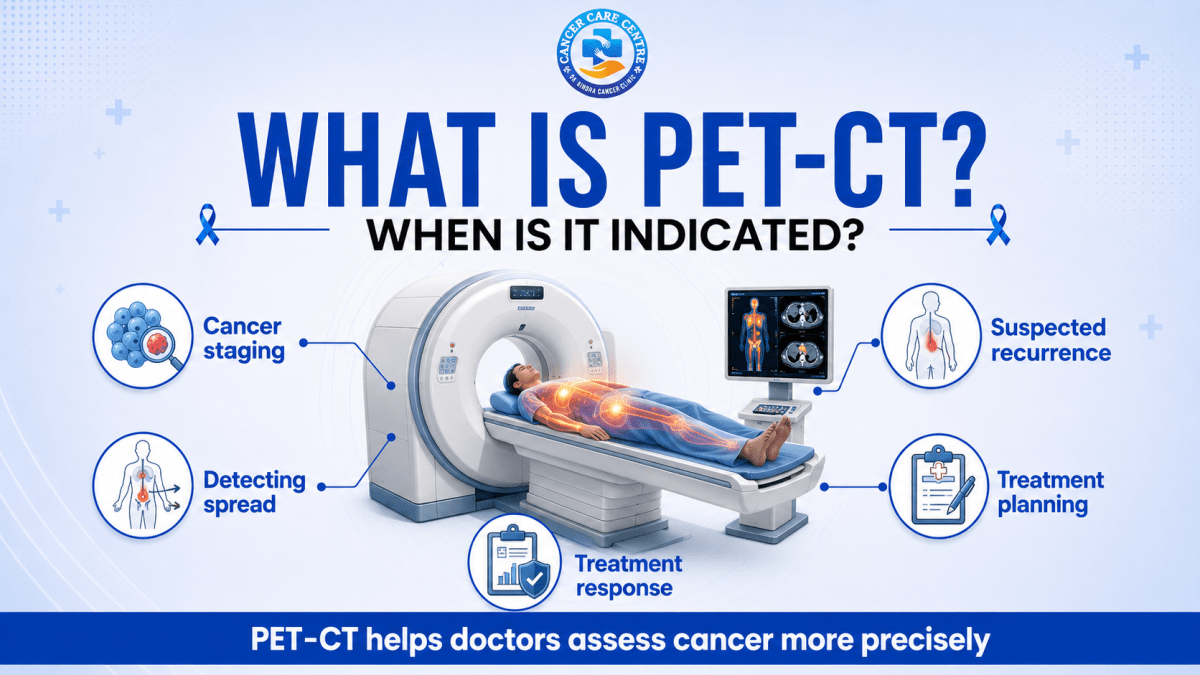
What Is a PET-CT Scan and How Are the Results Interpreted?
A PET-CT scan is an advanced imaging test frequently used in cancer care. Patients may encounter unfamiliar terms in their report such as “FDG avid,” “metabolically active,” “SUVmax” or “metabolic response.”
Understanding what these terms mean can make a PET-CT report easier to discuss with your doctor.
What Is a PET-CT Scan?
PET-CT combines two imaging technologies:
CT Scan
Computed Tomography provides detailed anatomical images showing the size, shape and location of structures within the body.
PET Scan
Positron Emission Tomography provides information about certain metabolic activities within tissues.
Combining both allows doctors to assess anatomy and metabolic activity at the same time.
What Is FDG?
One of the most commonly used tracers in cancer PET imaging is 18F-FDG.
FDG behaves similarly to glucose. Because many cancer cells use glucose at a higher rate than surrounding tissues, they may take up more FDG and appear more active on PET imaging.
When Is PET-CT Used in Cancer?
PET-CT may be recommended for several reasons depending on the cancer type.
Cancer Staging
PET-CT can help determine whether cancer is confined to its original location or has spread to lymph nodes or distant organs.
Evaluating Suspected Metastases
The scan can help identify suspicious areas elsewhere in the body.
Assessing Treatment Response
Doctors may compare PET-CT scans before and after treatment to assess changes in metabolic activity.
Investigating Possible Recurrence
PET-CT may be useful in selected patients when doctors suspect that previously treated cancer has returned.
Planning Biopsy or Radiation Treatment
In some circumstances, PET information can help identify suitable biopsy targets or assist with radiation planning.
What Does “FDG Avid” Mean?
FDG avid means that an area has absorbed more FDG tracer than surrounding tissues.
An FDG-avid area is not automatically cancer.
Inflammation and infection can also cause increased FDG uptake.
Certain normal organs naturally show significant tracer activity as well.
What Is SUV in a PET Scan?
SUV stands for Standardised Uptake Value.
It provides an estimate of how much tracer has accumulated within a particular area.
SUVmax refers to the highest measured SUV within the region being evaluated.
Does a High SUV Always Mean Cancer?
No.
There is no single SUV value that can universally separate cancer from non-cancerous conditions.
SUV can be influenced by:
- Tumour biology
- Inflammation
- Infection
- Blood glucose level
- Time between tracer injection and imaging
- Technical characteristics of the scanner
- Size of the lesion
Doctors therefore interpret SUV together with the appearance and location of the abnormality and the patient’s medical history.
Can PET-CT Miss Cancer?
Yes. PET-CT is a valuable imaging tool but is not perfect.
Some very small lesions may be difficult to detect. Certain slow-growing cancers may also show relatively low FDG uptake.
This is why a PET-negative finding cannot always completely exclude cancer.
Why Can PET-CT Be Positive After Surgery or Radiation?
Surgery, radiation, infection and inflammation can temporarily increase metabolic activity.
For this reason, the timing of PET-CT after treatment is important and should be decided by the treating medical team.
How Should You Read a PET-CT Report?
It is useful to review the report in the following order:
Clinical Indication
This explains why the PET-CT was requested.
Comparison
The radiologist may compare the current scan with an earlier PET-CT, CT or MRI.
Primary Tumour Site
The report describes whether the known tumour remains visible and whether it has changed.
Lymph Nodes
The report notes any suspicious metabolically active lymph nodes.
Distant Organs
The scan is assessed for suspicious findings elsewhere in the body.
Impression or Conclusion
This is usually the section where the nuclear medicine specialist summarises the most important findings.
What Does Metabolic Response Mean?
When a PET-CT is performed after treatment, doctors may assess whether the metabolic activity of the disease has reduced, disappeared, remained stable or increased.
These findings must be interpreted together with the type of cancer and treatment received.
PET-CT Should Not Be Interpreted in Isolation
Doctors combine PET-CT findings with:
- Biopsy results
- Pathology reports
- Previous scans
- Blood investigations
- Symptoms
- Physical examination
- Details of treatment already received
Conclusion
The most important question after a PET-CT is not simply, “What is my SUV?”
A more useful question is: “What do these PET-CT findings mean in the context of my diagnosis and treatment?”
PET-CT results should always be interpreted by the treating oncology team together with the patient’s complete medical history.
This article is intended for patient education and should not be used to self-interpret or self-diagnose cancer.